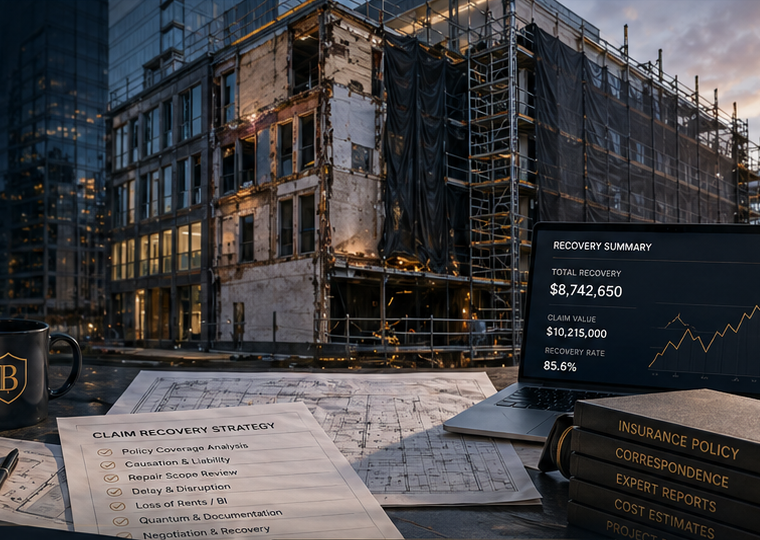
Insurance Recovery
Coverage strategy built around the property, not just the policy.
Serious insurance disputes usually turn on more than coverage language. They affect repair scope, reconstruction timing, funding pressure, project delay, and the owner's broader property economics at the same time. For qualifying serious matters, contingency-based representation may be available where the claim and economics support it.
Best First Step
Start with a short, non-confidential summary. If the loss is large enough to justify focused counsel, you will get a direct initial read and a clear next step.

Focused insurance-recovery counsel when reconstruction strategy, claim framing, and property economics all affect the outcome.
Construction + insurance focus
Construction and insurance disputes stay at the center of the work.
Owner-side matters for property owners.
Contingency-fee representation
We work on a contingency-fee basis rather than billing by the hour.
Clients do not pay unless the matter succeeds.
Millions recovered
Kelly McCann has recovered millions of dollars for property owners.
Through trial, arbitration, and settlement.
Construction pricing background
Background includes work as a construction cost estimator.
Useful when repair scope, reconstruction timing, and cost consequences all matter at once.
Knowledge Center
Construction and insurance articles give owners, advisors, and referral partners practical guidance on active disputes.
Why This Role Is Different
Why bring in focused special counsel instead of broader counsel?
Some insurance matters need focused claim strategy, not broader general representation. That is usually true when the loss is large enough that timing, scope, funding pressure, and property economics are all moving together.
Focused special counsel
Focused special counsel helps preserve the claim, organize the loss story, and keep the economics visible.
Broader counsel
Broader coverage, litigation, transaction, or local-counsel roles can stay where they already sit.
The role is the claim itself
The work centers on causation, scope, timing, code, delay, soft costs, and how the loss affects the property.
Useful when the carrier story is setting the frame
Owners often call when the file is drifting toward an insurer-driven version of the loss that does not match the business reality.
Built for property and project economics
The dispute is treated as a property problem and a funding problem, not just as policy interpretation.
Works with the broader team
Consultants, public adjusters, local counsel, ownership teams, and other advisors can stay in place while the claim gets focused owner-side strategy.
Why Aligned Economics Matters
Serious property losses sometimes need specialist counsel without a large hourly burn.
For the right insurance matter, fee structure can be part of the strategic fit. That is especially true when the dispute is already affecting reconstruction choices, reserve pressure, or the broader economics of the property.
For qualifying serious matters, contingency may be available once the loss, recovery path, and economics are assessed.
Lower friction when repair funding is already tight
A large property loss can already be straining capital, reserves, or lender relationships before the claim is properly framed.
Aligned economics for serious claim work
For the right matter, the fee structure can support focused owner-side claim work without a broad hourly-burn model.
Useful when the claim affects the asset now
This matters most when underpayment or delay is already influencing reconstruction, stabilization, or operating decisions.
Not every loss is the right fit
The seriousness of the loss, the recovery path, and the economics still need to justify focused counsel.
When To Call
Is this the point where the claim is starting to drift?
The right time to call is often before the carrier's version of the loss becomes the default version. These are common signs that the matter needs focused owner-side attention.
The loss story hardens quickly
Carrier framing around causation, exclusions, timing, code requirements, or mitigation can start shaping the economics before the owner's record is organized.
Coverage and project pressure split apart
Builder's risk, soft costs, delay, consultant work, and restoration planning often need to be managed as one owner-side problem, not as separate files.
Underpayment starts affecting the asset
Coverage disputes start affecting lender pressure, reconstruction choices, tenant confidence, and the owner's broader business decisions.
Matters Burnside Handles
Matters Burnside handles
The right time to call is often before the carrier's version of the claim becomes the default version.
Major property underpayment or denial
Commercial property losses where coverage position, scope, timing, and repair funding are all in play.
Builder's risk and project-loss disputes
Claims where delay, soft costs, repair sequencing, or completion pressure materially change the owner's position.
Code-upgrade, soft-cost, and timing disputes
Claims where the insurer's framing of timing, code, or scope materially shapes recovery.
Claims that touch both the project and the property
Insurance matters where consultants, contractors, or restoration strategy intersect with the owner's broader property problem.
Why Owners Hire Burnside
Why owners hire Burnside for serious insurance disputes.
Owners usually bring Burnside in when underpayment, reconstruction timing, and the broader business consequences of the loss start moving together.
Construction and insurance stay at the center
Burnside is a specialty construction and insurance law firm, not a broad general-litigation shop.
Finance, law, construction pricing, and real-estate study
Kelly McCann's background combines a finance degree, construction cost-estimating work, a J.D. with a CALI Award, and an M.S. in Real Estate.
Published guidance on construction and insurance issues
Construction and insurance articles give owners, advisors, and referral partners practical guidance on active disputes.
Contingency-fee representation
Burnside Law Firm works exclusively on a contingency-fee basis. Clients do not pay unless the matter succeeds.
Illustrative Scenarios
Examples of serious insurance disputes.
These summary-level examples show how serious insurance matters get more expensive when timing, scope, and business pressure start moving together.
Illustrative Scenario
Illustrative property-loss scenario with repair cost and revenue pressure
Asset Type
Income-producing property
Problem Type
Property damage + rent-loss pressure
Where Value Gets Exposed
Repair scope, restoration timing, and the revenue story all need to move together.
Where Burnside Helps
Useful when the physical-damage file and the operating picture need to be framed in one commercially coherent story.
Why It Matters
The leverage question usually turns on documentation, timing, and how early the record is organized.
Illustrative Scenario
Illustrative project-loss scenario where scope is not the whole story
Asset Type
Major property or project loss
Problem Type
Insurance recovery + reconstruction strategy
Where Value Gets Exposed
Soft costs, code, delay, and reconstruction timing can move the economics faster than the headline repair number.
Where Burnside Helps
Useful when the claim has to be built around the property or project economics rather than around raw line items alone.
Why It Matters
The file gets clearer when timing, reconstruction strategy, and claim strategy stay aligned.
Illustrative scenarios are shown in summary form only. They are not client descriptions and do not guarantee outcomes.
What This Work Covers
What Burnside usually handles in insurance recovery.
This is for large owner-side property and project claims where recovery value depends on timing, scope, and commercial context.
Commercial property and casualty claims presentation
Builder's risk and project-loss disputes
Soft cost, code-upgrade, and delay components
Reservation-of-rights response and strategic positioning
Coverage-related settlement strategy and dispute escalation
Coordination with consultants, adjusters, damages experts, and local counsel
When Focused Special Counsel Often Makes Sense
When insurance recovery needs focused counsel
Coverage disputes rarely stay confined to policy language. They move with repair cost, reconstruction timing, and the business consequences of underpayment.
Approach
Three steps usually keep the matter commercial and controlled.
Start here when the claim is large, the record is still forming, and the carrier's narrative is beginning to harden.
01
Stabilize the facts
The first move is to understand the asset, the physical event, the coverage issues, and the business risks driving urgency.
02
Define the claim architecture
The work then organizes coverage, loss presentation, reconstruction timing, and damages support into a coherent owner-side position.
03
Advance leverage deliberately
Negotiation, formal dispute posture, and expert coordination are calibrated to improve recovery without losing sight of the property's operational realities.
Related Reading
Notes that often help owners and referral partners earlier.
This guidance helps sharpen issue-spotting before the carrier's framing becomes the default version of events.
Referral Path
Bring in owner-side insurance counsel before the carrier narrative settles in.
Call before the carrier narrative hardens if the claim is large, the reconstruction record is still forming, or the recovery story is being framed too narrowly.