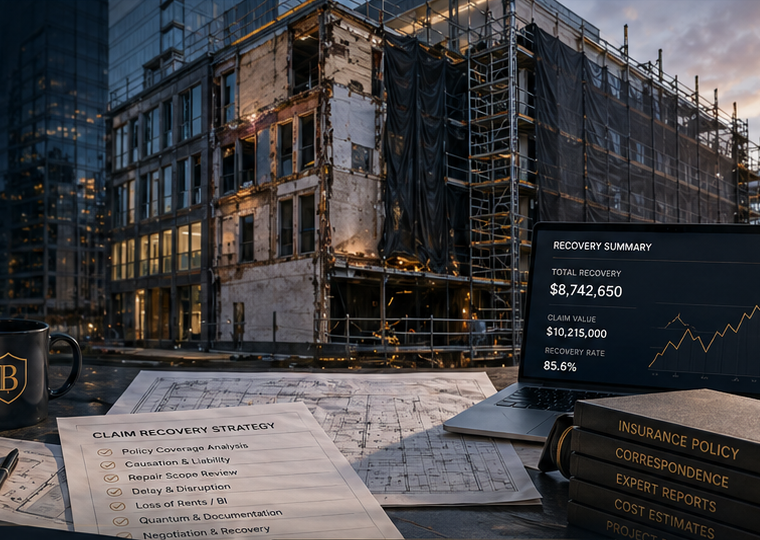
Loss of Rents / Business Interruption
Revenue-loss disputes require asset fluency as much as legal fluency.
Some of the largest owner-side losses turn on rent roll, downtime, restoration sequencing, and the way a property gets back to normal operations. Burnside focuses on the revenue issues that often get flattened inside the physical-damage file. For qualifying serious matters, contingency-based representation may be available where the claim and economics support it.
Best First Step
Start with a short, non-confidential summary. If the revenue exposure is large enough to justify focused counsel, you will get a direct initial read and a clear next step.

Focused counsel when the revenue story, restoration timing, and claim strategy all need to be built together.
Construction + insurance focus
Construction and insurance disputes stay at the center of the work.
Owner-side matters for property owners.
Contingency-fee representation
We work on a contingency-fee basis rather than billing by the hour.
Clients do not pay unless the matter succeeds.
Millions recovered
Kelly McCann has recovered millions of dollars for property owners.
Through trial, arbitration, and settlement.
Construction pricing background
Background includes work as a construction cost estimator.
Useful when repair scope, reconstruction timing, and cost consequences all matter at once.
Knowledge Center
Construction and insurance articles give owners, advisors, and referral partners practical guidance on active disputes.
Why This Role Is Different
Why bring in focused special counsel instead of broader counsel?
Some revenue-loss disputes need focused claim strategy, not broader general representation. That is usually true when rent loss, downtime, restoration timing, and the operating story are all materially affecting value.
Focused special counsel
Focused special counsel helps build the revenue story with the same discipline as the physical-damage file.
Broader counsel
Broader insurance, property-management, accounting, or general litigation roles can stay where they already sit.
The revenue story gets its own discipline
Focused counsel keeps rent loss, downtime, and restoration timing from disappearing inside the physical-damage file.
Useful when operations affect claim value
Owners often call when lease economics, concessions, occupancy, or stabilization assumptions are already changing the recovery story.
Built for asset-level economics
The dispute is treated as an operating and value problem, not just as a generic damages issue.
Works with broader insurance and property teams
The broader casualty response, property management, accounting, and advisor roles can stay in place while the revenue claim gets focused attention.
Why Aligned Economics Matters
Serious rent-loss disputes sometimes need specialist counsel without a large hourly burn.
The fee structure can be part of the strategic fit when revenue loss is already affecting operations, reserves, lender conversations, or the path back to stabilization. The issue is whether the matter is serious enough to justify focused revenue-claim work now.
For qualifying serious matters, contingency may be available once the revenue exposure, claim path, and economics are understood.
Revenue pressure is already real pressure
Lost rent, business interruption, and prolonged downtime can strain operations before the claim is properly built.
Aligned economics can reduce hesitation
For qualifying serious matters, contingency can make it easier to bring in specialist help while the revenue story is still shapeable.
Useful when the physical-damage file is swallowing the economics
The right structure can support disciplined revenue-claim work without treating it as an afterthought.
The issue still has to justify focused counsel
The claim has to be serious enough, economically coherent enough, and early enough for the model to make sense.
When To Call
When the revenue story is starting to slip.
Claim value often turns on timing, leasing facts, and how the operating story is documented. These are common signs that the revenue file needs focused attention.
The revenue story gets folded into the property file
Lost-rent and business-interruption issues are easy to under-develop when the matter is driven only through repair cost, physical damage, or contractor disputes.
Timing usually becomes the fight
Period-of-restoration fights, occupancy assumptions, lease turnover, and mitigation narratives can change the claim value dramatically.
Generic models miss how the asset actually operates
The persuasive case is built around how the property actually earns, leases, stabilizes, and returns to performance rather than around generic damages language.
Matters Burnside Handles
Matters Burnside handles
These are usually worth special counsel when the revenue story is large, contested, or being oversimplified inside the physical-damage file.
Rent-loss claims tied to major property damage
Matters where downtime, period of restoration, and lease realities materially affect recovery value.
Business interruption and operating displacement
Claims where the asset's actual operating pattern matters more than abstract damages language.
Restoration timing disputes
Cases where the path back to normal operations is contested and needs to be built credibly.
Lease-driven damages presentation
Matters where rent roll, concessions, renewals, downtime assumptions, or tenant sensitivity shape the loss story.
Why Owners Hire Burnside
Why owners hire Burnside for serious rent-loss disputes.
The revenue story usually matters most when downtime, restoration timing, and occupancy assumptions are all under pressure. Owners usually call Burnside when that story is being flattened or underdeveloped.
Construction and insurance stay at the center
Burnside is a specialty construction and insurance law firm, not a broad general-litigation shop.
Published guidance on construction and insurance issues
Construction and insurance articles give owners, advisors, and referral partners practical guidance on active disputes.
Contingency-fee representation
Burnside Law Firm works exclusively on a contingency-fee basis. Clients do not pay unless the matter succeeds.
Illustrative Scenarios
Examples of serious rent-loss disputes.
These scenario cards make rent-loss pressure, timing issues, and owner-side leverage easier to recognize.
Illustrative Scenario
Illustrative property-loss scenario with repair cost and revenue pressure
Asset Type
Income-producing property
Problem Type
Property damage + rent-loss pressure
Where Value Gets Exposed
Repair scope, restoration timing, and the revenue story all need to move together.
Where Burnside Helps
Useful when the physical-damage file and the operating picture need to be framed in one commercially coherent story.
Why It Matters
The leverage question usually turns on documentation, timing, and how early the record is organized.
Illustrative scenarios are shown in summary form only. They are not client descriptions and do not guarantee outcomes.
Recovery Elements
What the claim usually turns on.
This work is for claimholders who need the revenue story treated with the same discipline as the physical-damage file.
Loss of rents and vacancy assumptions
Business interruption and operating displacement
Period of restoration disputes
Lease obligations, concessions, and tenant retention pressure
Soft costs and timing-sensitive project economics
Presentation strategy for accountants, consultants, and insurers
How The Claim Gets Built
Three moves usually shape the revenue file.
The revenue claim usually gets stronger when the economics, the restoration path, and the lease story are built together.
01
Understand the lease economics
Rent roll, concessions, renewals, downtime assumptions, and tenant sensitivity become part of the claim strategy.
02
Build the restoration narrative
The timeline must be grounded in the actual path back to operations, not just in abstract schedule claims.
03
Present the loss credibly
The damages case has to make business sense to insurers, mediators, experts, and decision-makers.
When Focused Special Counsel Often Makes Sense
When a rent-loss dispute needs focused counsel
Loss-of-rents and business-interruption issues usually become more expensive when the revenue story is treated like a side note to the physical-damage file.
Related Reading
Useful notes when the revenue story needs its own discipline.
This guidance is useful when the physical-damage file is swallowing the rent-loss story or flattening operating facts into a generic estimate.
Referral Path
Send the matter while the revenue story can still be documented correctly.
Referral routes stay direct for matters where lost income, downtime, and restoration timing are driving the result.